Clione limacina (Phipps, 1774)Common name(s): Sea angel |
|
| Synonyms: Clione kincaidi, Clione elegantissima, Clione papillonacea, Trichocyclus hansineensis | 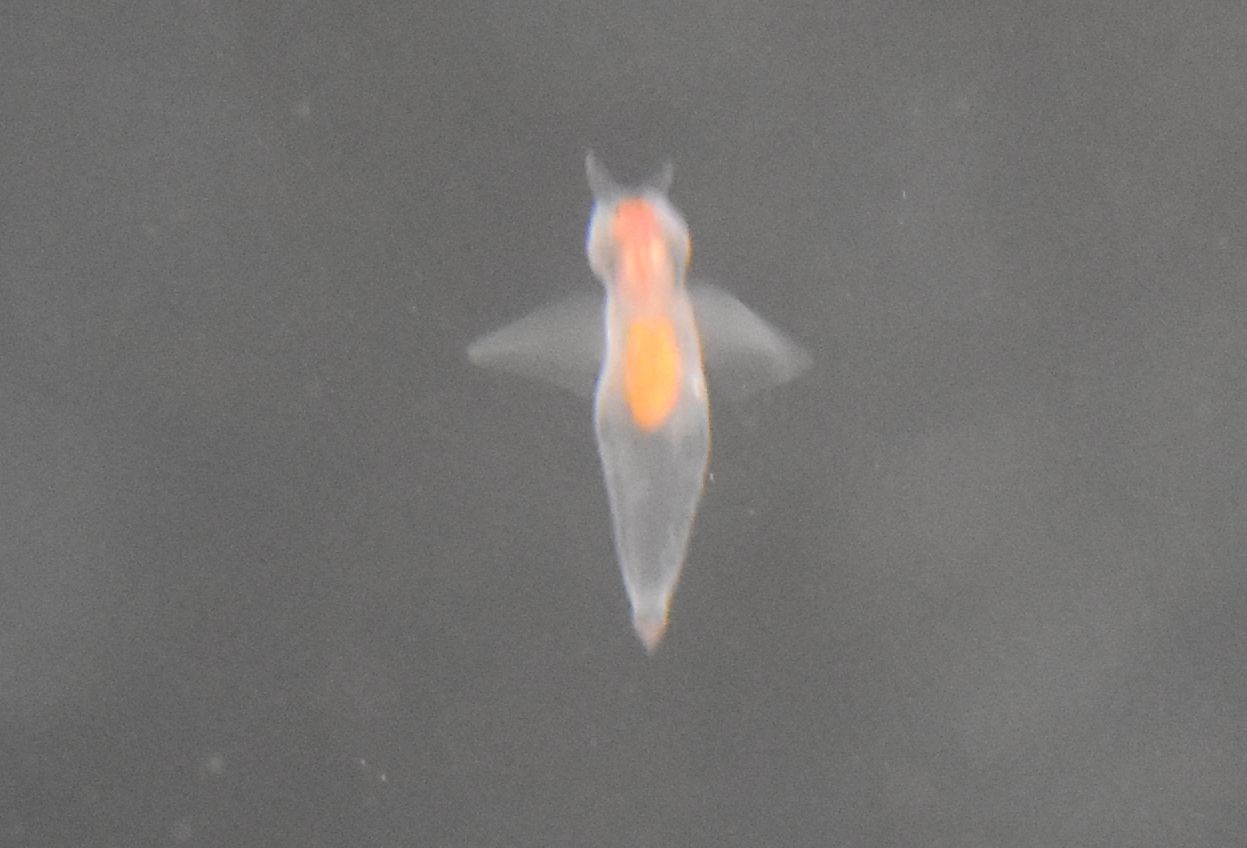 |
|
Phylum Mollusca
Class Gastropoda
Order Gymnosomata
|
|
| Clione limacina, 1 cm long, captured swimming near Cornet Bay dock by Jamie Field, June 2026. Note the two antennae on the anterior end. The animal is swimming upward. | |
| (Photo by: Dave Cowles, July 2026) | |
Description: This species is one of the few gastropod mollusks (a prosobranch) that swims actively through the water. The orange gold viscera visible inside the slender transparent body and the winglike, flapping extensions of the foot on both sides of the body, plus its anterior-upward stance in the water all serve to remind one of an angel. It has no chromatophores and no protrusible proboscis or gills. Posterior part of body is mostly clear but may have some red pigment. It has two antennae (often visible) and 3 pairs of buccal cones in the mouth (which have red on them but are not usually extended). Length to 8 cm.
How to Distinguish from Similar Species: This is the most common pelagic gastropod in the northeast Pacific. Another local Gymnosomata species, Pneumodermopsis macrochira, but it has stellate chromatophores, a large, protrusible proboscis, and an anterior and posterior pair of gills..Cliopsis krohni is a rare pelagic species which has a much wider, vase-shaped body. Paraclione longicaudata has 2 pairs of buccal cones.
Geographical Range: In cold and temperate oceans in the northern hemisphere, northern Alaska to northern Mexico along the American Pacific coast.
Depth Range: Surface to 600 m.
Habitat: Pelagic
Biology/Natural
History: The population
of this species seems to grow rapidly in late winter, but ioccasional
ndividuals
can be found year-round. In the west American coast it seems to
specialize
for feeding on the swimming pteropod
Limacina helicina, even though Cliona
is also a pteropod. This animal swims vigorously for its size with its
lateral
foot flaps
but still moves only slowly (movie)
| Return to: | |||
| Main Page | Alphabetic Index | Systematic Index | Glossary |
References:
Dichotomous Keys:Carlton, Kozloff, 1987, 1996
General References:
Lamb and Hanby, 2005
Scientific Articles:
Web sites:
General Notes and
Observations: Locations, abundances,
unusual behaviors:
Authors and Editors
of Page:
Dave Cowles (2026): Created original page
CSS coding for page developed by Jonathan Cowles
Salish Sea Invertebrates web site provided courtesy of Walla
Walla University