Leuckartiara longicalcar Schubert, 2018Common name(s): Tall-top jelly, Long-spur jelly |
|
| Synonyms: | 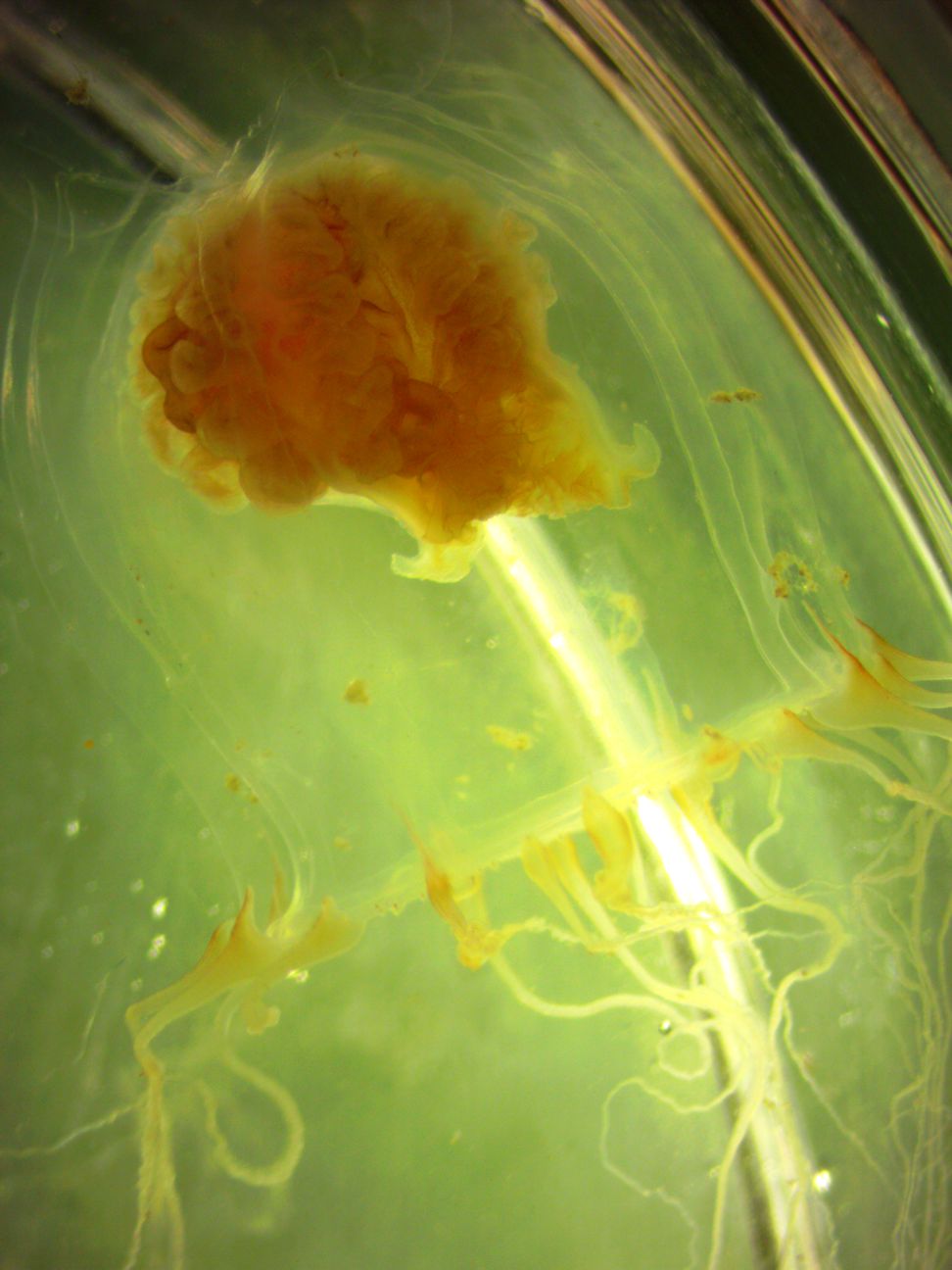 |
|
Phylum Cnidaria
Class Hydrozoa
Order Hydroida
Suborder Athecata (Anthomedusae)
Family Pandeidae
|
|
| Leuckartiara longicalcar captured at night at the Cornet Bay docks by Jamie Fields. Height of bell about 1.2 cm, with the extension on top of the bell adding 1 more cm. The extension is mostly out of the photo at the top left. Note the horseshoe-shape of the bright orange gonads connected to the manubrium, and the wide radial canals visible on the right and the left.. | |
| (Photo by: Dave Cowles, July 2026) | |
Description: This species has four broad radial canals with uneven width along each canal. It has 12-48 unbranched, highly extendable tentacles, without obvious batteries of nematocysts, distributed around the margin of the bell. The tentacular bulbs and the proximal part of the tentacles are orange, yellow, or brownish. Each tentacular bulb has a short, tapering spur extending upward along the exumbrella of the bell. Many small bumps like vestigial tentacles occur along the bell margin between the tentacles. Both the functional tentacles and the vestigial tentacles have small red ocelli. This species also has a very unusual flap or bulge of bell material extending from the top of the bell, something like a large stovepipe hat or flap. In this individual the length of the extension was close to the height of the entire bell below that point, nearly doubling the total bell height. The manubrium is short (doesn't normally reach down as far as the margin of the bell) and ends with four short, slightly frilly off-white or yellowish flaps. The horseshoe-shaped gonads are thick and bright orange, and are attached to the sides of the manubrium.
Note 1: Both the Kozloff and Carlton Keys plus Wrobel and Mills (1998) state that at least part of the manubrium or stomach of Leuckartiara sp. is attached to the radial canals by "mesenteries" for at least part of their length. However, I was not able to verify this in my careful observations of this species. The manubrium and radial canals appeared to be completely separate with space between them except at the very top where they were both attached to the stomach. A firm touch to the side of the bell caused the radial canals to oscillate with the bell but neither the manubrium nor the attached gonads oscillated with them. Part of the mass on top likely includes the stomach, whose attachment to the radial canals may be broader than usual.
How to Distinguish from Similar Species: L. foersteri is a rare species which is very similar but does not have the spurs extending upward from the tentacular bulbs.
Geographical Range: Mostly coastal along British Columbia and Washington, with a few reported observations in California.
Depth Range:
Habitat: Pelagic
Biology/Natural History: These
free-living medusae
are short-lived and prey on other gelatinous plankton species. The polyp
stage exists as small, moderately branched colonies.
| Return to: | |||
| Main Page | Alphabetic Index | Systematic Index | Glossary |
References:
Dichotomous Keys:Carlton et al 2007 (as Leuckartiara spp.)
Kozloff, 1987, 1996 (as Leuckartiara spp.)
General References:
Lamb
and Hanby 2005
Wrobel and Mills 1998 (as Leuckartiara
spp.)
Scientific Articles:
Web sites:
General Notes and Observations: Locations, abundances, unusual behaviors:
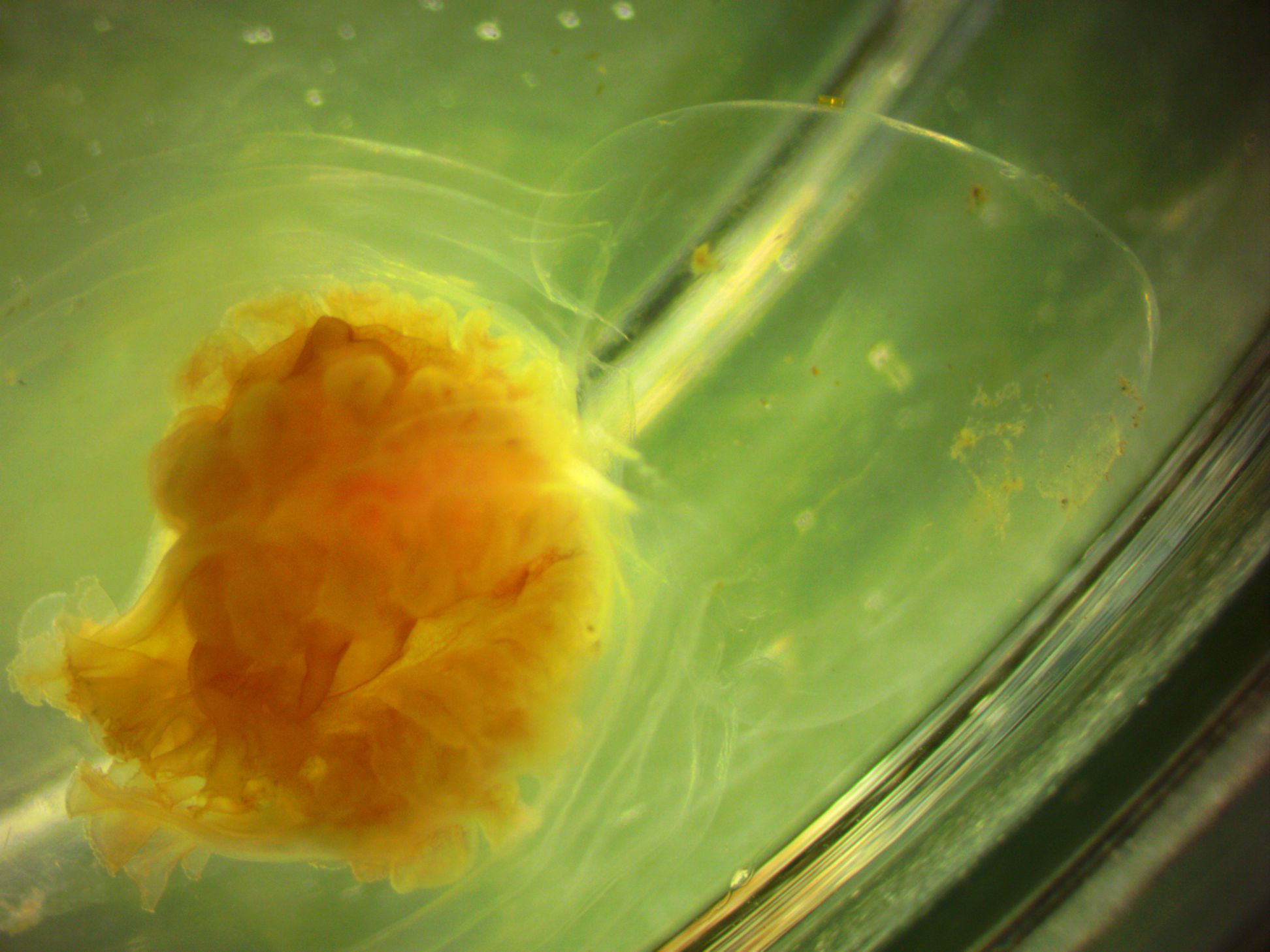
In this photo the large extension on the bell
tip can be clearly seen. Photo by Dave Cowles, July 2026
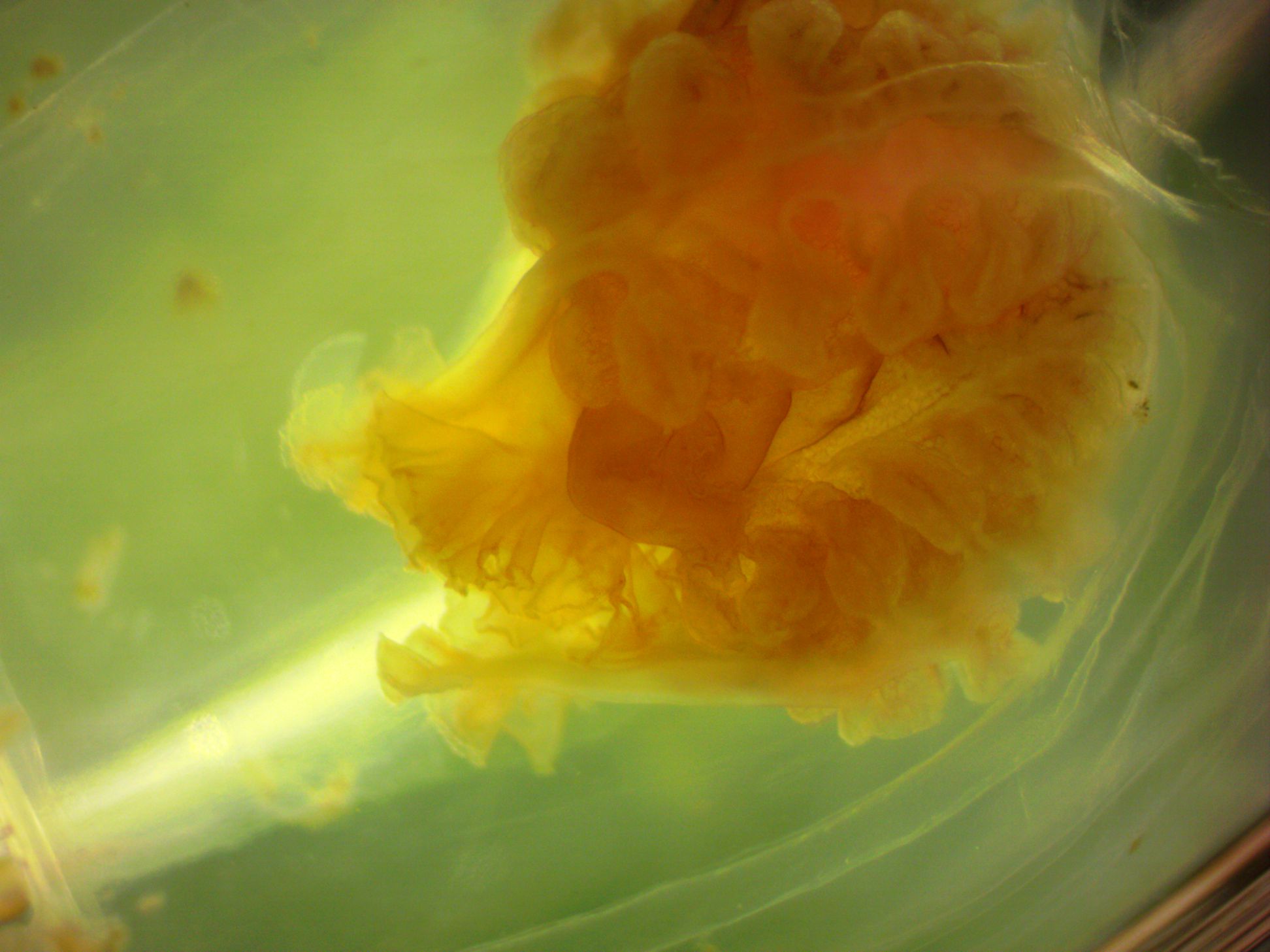
Note that the manubrium,
visible through the clear bell
at the bottom left of the colored gonadal mass, is short and light yellow
or off-white, with 4 slightly frilly lobes. Note also the wide radial
canal with uneven edges crossing toward the bell
margin at the bottom right. Photo by Dave Cowles, July 2026.
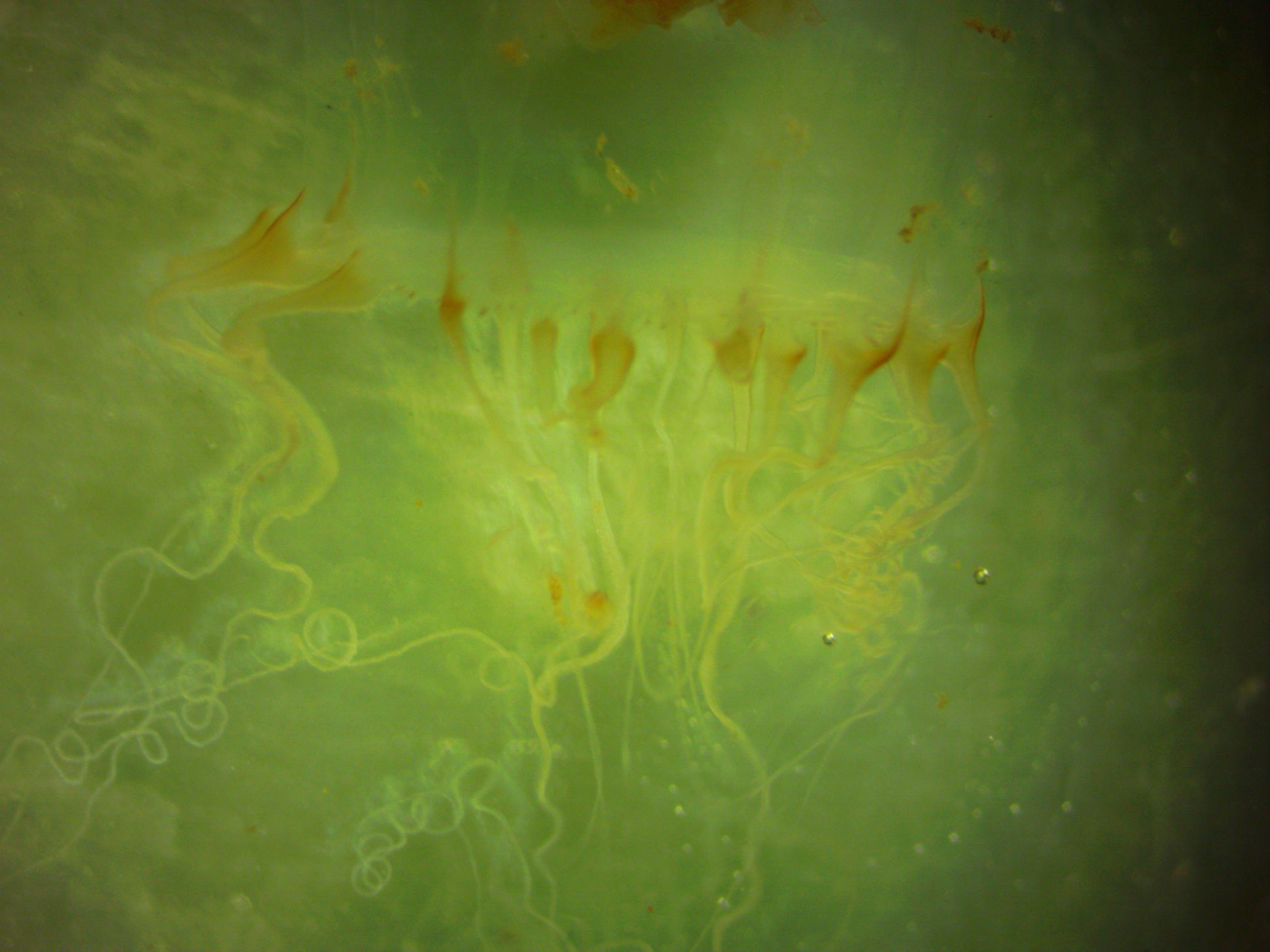
The tentacles
arranged idividually along the bell
margin are highly extensible but not covered with batteries of stinging
cnidocytes.
Note the coloration on the tentacle
bulbs, and the fact that most of them have spur-like extensions pointing
upward along the outer surface of the medusa.
There are small bumps like vestigial
tentacles between
the functional tentacles,
and both the developed tentacles
and the vestigial
ones have tiny red eyespots on the tentacle
bulb. Photo by Dave Cowles, July 2026
Authors and Editors of Page:
Dave Cowles (2026): Created original page
CSS coding for page developed by Jonathan Cowles
Salish Sea Invertebrates web site provided courtesy of Walla
Walla University